

In the realm of power quality management, Harmonic Filter Cabinets play a crucial role in mitigating the adverse effects of harmonics in electrical systems. As a leading supplier of Harmonic Filter Cabinet, I often encounter the question: "Which one is better, an active or a passive Harmonic Filter Cabinet?" This blog post aims to provide a comprehensive analysis of both types of filter cabinets to help you make an informed decision.
Understanding Harmonics and the Need for Filters
Before delving into the comparison between active and passive Harmonic Filter Cabinets, it's essential to understand what harmonics are and why they pose a problem. Harmonics are unwanted frequencies that are multiples of the fundamental frequency (usually 50 or 60 Hz) in an electrical system. They are generated by non - linear loads such as variable frequency drives, rectifiers, and electronic ballasts.
Harmonics can cause a variety of issues, including overheating of transformers and cables, premature equipment failure, interference with communication systems, and inaccurate metering. To address these problems, Harmonic Filter Cabinets are installed in electrical systems to reduce the harmonic distortion and improve power quality.
Passive Harmonic Filter Cabinets
Passive Harmonic Filter Cabinets are the traditional solution for harmonic mitigation. They consist of passive components such as capacitors, inductors, and resistors arranged in a specific configuration to create a low - impedance path for harmonic currents. When a harmonic current is present in the system, it flows through the filter instead of the main electrical network, thereby reducing the harmonic distortion at the point of connection.
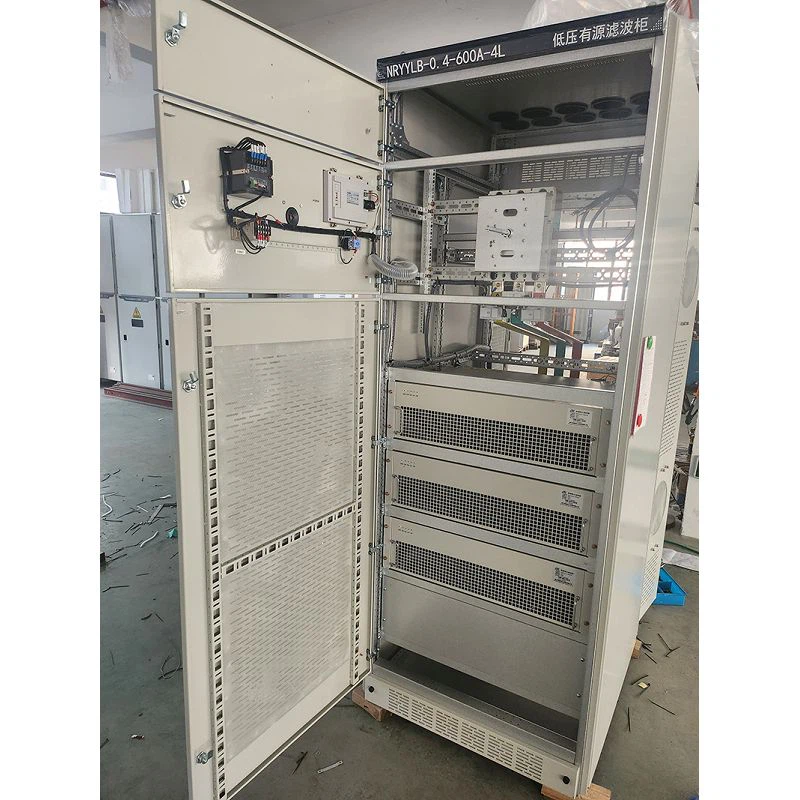

Advantages of Passive Harmonic Filter Cabinets
- Cost - effectiveness: Passive filters are generally less expensive than active filters. The cost of the passive components (capacitors, inductors, and resistors) is relatively low, and the installation and maintenance costs are also minimal. This makes them an attractive option for small to medium - sized industrial applications where the budget is limited.
- Simple design and operation: Passive filters have a straightforward design and do not require complex control systems. They operate passively, meaning they do not need an external power source to function. Once installed, they can provide continuous harmonic mitigation without the need for constant monitoring and adjustment.
- High reliability: Since passive filters have no active electronic components, they are less prone to failure due to electronic malfunctions. They have a long service life and can withstand harsh environmental conditions, making them suitable for industrial applications.
Disadvantages of Passive Harmonic Filter Cabinets
- Fixed filtering characteristics: Passive filters are designed to target specific harmonic frequencies. Once installed, their filtering characteristics are fixed, and they may not be able to adapt to changes in the harmonic spectrum of the electrical system. If the load characteristics change or new non - linear loads are added, the passive filter may become less effective.
- Resonance issues: Passive filters can create resonance conditions in the electrical system. Resonance occurs when the natural frequency of the filter coincides with the harmonic frequency of the system, resulting in a significant increase in the harmonic current and voltage. This can cause damage to the filter and other electrical equipment in the system.
- Limited filtering performance: Passive filters are typically less effective in reducing high - order harmonics and may not be able to achieve a very low total harmonic distortion (THD) level, especially in systems with complex harmonic spectra.
Active Harmonic Filter Cabinets
Active Harmonic Filter Cabinets are a more advanced solution for harmonic mitigation. They use power electronics and control systems to actively inject counter - harmonic currents into the electrical system to cancel out the harmonic currents generated by non - linear loads.
Advantages of Active Harmonic Filter Cabinets
- Adaptive filtering: Active filters can continuously monitor the harmonic spectrum of the electrical system and adjust the injected counter - harmonic currents accordingly. This allows them to adapt to changes in the load characteristics and effectively reduce harmonic distortion under various operating conditions.
- High filtering performance: Active filters can achieve a very low THD level, even in systems with complex harmonic spectra. They can effectively reduce both low - order and high - order harmonics, providing a high - quality power supply for sensitive equipment.
- No resonance issues: Unlike passive filters, active filters do not create resonance conditions in the electrical system. They operate independently of the system impedance and can provide stable harmonic mitigation without the risk of resonance - related problems.
Disadvantages of Active Harmonic Filter Cabinets
- High cost: Active filters are more expensive than passive filters. The cost of the power electronics components and the control system is relatively high, and the installation and maintenance costs are also significant. This makes them less suitable for small - scale applications with a limited budget.
- Complex design and operation: Active filters have a more complex design and require a sophisticated control system to operate. They need an external power source to function, and their performance is highly dependent on the accuracy of the control algorithm. This requires skilled personnel for installation, commissioning, and maintenance.
- Lower reliability: Active filters have more active electronic components, which are more prone to failure due to electronic malfunctions. They may require more frequent maintenance and replacement of components, which can increase the overall operating cost.
Application Considerations
When choosing between an active and a passive Harmonic Filter Cabinet, several factors need to be considered, including the type of load, the harmonic spectrum, the budget, and the required filtering performance.
- Type of load: If the load is relatively stable and the harmonic spectrum is well - defined, a passive filter may be sufficient. For example, in a simple industrial process with a few non - linear loads, a passive filter can effectively reduce the harmonic distortion. On the other hand, if the load is dynamic and the harmonic spectrum changes frequently, an active filter is more suitable. For instance, in a data center where the load can vary significantly depending on the server usage, an active filter can provide better harmonic mitigation.
- Harmonic spectrum: If the harmonic spectrum contains mainly low - order harmonics, a passive filter can be a cost - effective solution. However, if high - order harmonics are present or the harmonic spectrum is complex, an active filter is required to achieve a low THD level.
- Budget: The budget is an important consideration. If cost is a major concern, a passive filter may be the preferred option. However, if the application requires high - performance harmonic mitigation and the budget allows, an active filter is recommended.
- Required filtering performance: If a very low THD level is required, especially for sensitive equipment such as medical devices or precision manufacturing equipment, an active filter is the better choice.
Our Product Offerings
As a supplier of Harmonic Filter Cabinets, we offer a wide range of 0.4kv 300A Low Voltage Thd Filter and Capacitor Harmonic Filter solutions to meet the diverse needs of our customers. Our passive filters are designed for cost - effective harmonic mitigation in small to medium - sized applications, while our active filters provide high - performance harmonic reduction for complex and dynamic electrical systems.
Conclusion
In conclusion, both active and passive Harmonic Filter Cabinets have their own advantages and disadvantages. The choice between the two depends on the specific requirements of the electrical system, including the type of load, the harmonic spectrum, the budget, and the required filtering performance. As a professional supplier of Harmonic Filter Cabinets, we can provide you with expert advice and customized solutions to ensure that you select the most suitable filter for your application.
If you are interested in our Harmonic Filter Cabinets or need further information, please feel free to contact us for a detailed consultation. We are committed to providing high - quality products and excellent customer service to help you improve the power quality of your electrical system.
References
- "Power Quality in Electrical Systems" by Badrul Chowdhury and Mohammad Hasan Ali.
- IEEE Standard 519 - 2014, "IEEE Recommended Practices and Requirements for Harmonic Control in Electrical Power Systems".
- "Harmonic Filter Design and Application" by Richard C. Dugan, Mark F. McGranaghan, and Surya Santoso.